


Meteorites
Text to be added - this page is still under construction
Curious about Meteorites? Let’s discover!
Title 1
To be continued
To be continued

Picture: VUB/ULB & IPF
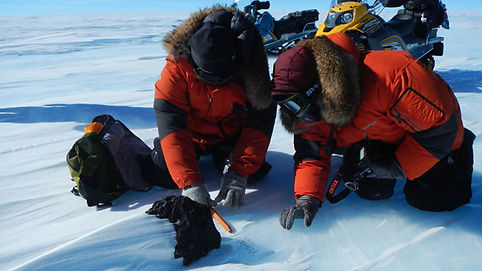
Prof. Steven Goderis posing with a meteorite found near the Princess Elisabeth Antarctica station.
Title 2
The sun is an active star that continuously emits energy into space in the form of charged particles.
The Earth is protected against these particles by its own magnetic field, that is generated by movements of masses in the Earth's metal-rich outer core. However, storms and eruptions on the sun can cause disturbances in the Earth's magnetic field, called geomagnetic storms.
The Earth's magnetic field protects it from particles in space.
The sun's outbursts of energy can reach the Earth and disturb it's magnetic field, we call this geomagnetic storms.
When the electrons reach the Earth's magnetic field, they accelerate along the magnetic field lines and move towards the poles, where they enter the Earth's atmosphere.
They collide with atoms like nitrogen and oxygen, exciting these atoms to higher energy levels. When these, in turn, fall back to their original energy level, they emit light. This happens in the upper atmosphere, between 80 and 500 km height.
Energised particles reach the polar regions via the magnetic field lines of the Earth, resulting in Aurora.
Red Aurora are not very common. They are emitted from Oxygen atoms at around (200 to) 300-500 km height. They occur at loer latitudes than the classic green ones. They are usually associated with geomagnetic storms.
Title 3
The sun's activity is not constant in time, it has an 11-year cycle, which is in upswing and quite active now (2024). There are also short term variations and irregularities.
Title 4
Apart from the 11-year cycle, there's also a seasonality: each year around the equinoxes, thus in spring and autumn, Auroral activity is higher. This has been explained by Russell & McPherson in 1973, hence calling the phenomenon the 'Russell-McPherron effect', and by an additional effect called the equinoctial effect.
Just like the Earth, the Sun has it's own magnetic field. This field can be prolonged or carried towards Earth by eruptions from the solar surface ( solar wind). The magnetic fields of Earth and Sun are not parallel to one another: we know the Earth's axis is tilted around 23,5° towards or away from the sun. Twice a year, however, the axis of the Earth is not tilting away from or towards the Sun, but is semi-parallel to the North-South axis of the sun's magnetic field.
Detecting meteorites in Belgium
In Belgium we can detect meteorites in the air by use of radio signals. How this works is explained in the video below, created by BIRA-IASB.
Impact of Aurora
Space weather impacts technology, such as disrupting satellite communications, GPS signals, and even power grids. It also poses risks to astronauts and spacecraft by increasing radiation levels. Scientists monitor space weather to mitigate these risks and protect critical infrastructure.
Meteorites at Princess Elisabeth Antarctica
We are lucky to be located at 71°57' South, within the region covered by the Southern Auroral oval. This means we oftentimes catch Auroral activity on our webcam at night. Our team rarely sees Aurora live, because our fieldwork season runs from early November till end of February, when the days are very long and nights are short.
This picture was taken on the morning of October 10th, at 01 AM. The camera is pointing to the Southwest.
The aurora camera on the roof of the PEA station.
Aurora is being studied, however, year-round at Princess Elisabeth Antarctica. A team of researchers from NIPR, the Japanese Institute of Polar Research, led by Prof. Kadokura, has installed an Aurora camera on the rooftop of our station. It captures the whole sky in one single 360° image. The research studies the onset mechanisms of auroral substorms, temporal & spatial variations in aurora, and the wave-particle interactions in storms & substorms. Apart from the Aurora camera, there is also a Fluxgate magnetometer, and a GNSS (Global Navigation Satellite System) antenna.
Extra information & links
Here are some links to educational materials developed by other specialised organisations:
